All Things Data
So, for my data metrics class, Joey, our awesome professor, has asked us to start a blog and keep updating it throughout the course. After many weeks of trying to do this via Github, I’ve given up and decided that this would be less of a chaotic mess of thoughts. Still chaos, but just less. SO. This is the place. This is the place where you’ll be able to find EVERYTHING DATA METRICS.
Assignment #7 - MORE LIFE EXPECTANCY
This assignment I found to be a lot easier to work through. I think that both has to do with the fact that I’ve worked with HTML before and I feel like I’m finally starting to better understand how things work in p5.js. As well as in assignment 6, I found myself better able to use and understand the p5 library. It’s been very useful to be able to follow along with Joey’s code example in this assignment, as well as with the template. Everything was mostly set up and was very easy to work with to make this work. I was also feeling a little bit bitter after going down a rabbit hole on life expectancy, which is reflected in the content of my website. Hope you enjoy reading!
Assignment #6 - Life Expectancy
This is the assignment that really got me. After I looked at the code template Joey provided us to set up our p5 sketches, as well as looking through the codes of many other people in my class, I started to understand how certain things work. I think my mistake was trying to jump right in, rather than understand how and why certain things worked. I finally was able to get the hang of things (except for breaking my code because I capitalized a word, and that really did break everything) and I was able to add a little image, change some colors, change some fonts, and really try to make this look more engaging, rather than a boring black & white page. Again, taking an existing code and working through it really helped me frame just how much p5.js can do. Enjoy my sketch!
Assignment #5 - Visualizing Co2 Emissions
So, building this visualization from scratch really intimidated me and after a few not so successful attempts at it, I put it down. I decided to come back to it and approach it with a different point of view. I decided to move backwards. So, I started with the code Joey provided (shoutout Joey, best prof of the year award goes to you!) and then toggle it here and there to try to better understand things. Little tweaks appear in my “final” version - but what was most rewarding about this was getting to see how things could and would shift with the tiniest changes made in the code. I was getting really hung up on not being able to see the end of the x-axis, and I tried to change the canvas size as well as the increment of years on the x-axis, but alas, that did not really work. Actually, I broke everything trying to do this, so I reverted back.

Visual representation of how I’m feeling at this point of the semester:
October 30, 2018.
Assignment #3 - How does computation and data visualization relate to your research interests?
My research interests are in the space of healthcare, immigration reform and advocacy, and refugee rights. I see a huge role for computation and overall data collection/visualizations in these spaces -- just look at any health related report and you'll see data visualizations all over it. It’s important to have a basic understanding of this simply because, especially in the healthcare world, people like to look at and measure results. This is often the only way programs and such can prove outcomes which can often lead to more positive change within the overall healthcare world. I think I am particularly interested in coding because it makes things and can make huge data sets easier to process, understand, and more readable for other people. Coding is something I used to do back in high school, but it was limited to HTML and CSS coding. I remember back then I loved spending time creating websites and making my ideas come to life. I’m looking forward to reentering the world of coding, this time for practical uses that could even help with the measurement needed in terms of my thesis project.
Assignment #2 - Dear Data Mobility
I really appreciated how this project made me realize my routine is kind of all over the place. It makes sense, it was still the beginning of the school year, I had just moved, and I was still getting a bunch of my things up from MD — since I had to do my move essentially on my own. This made me also realize that I don’t really go anywhere unless I have to or I’m feeling social (which is rare). Plenty of time went by, but I really did not get out much. Oh well.


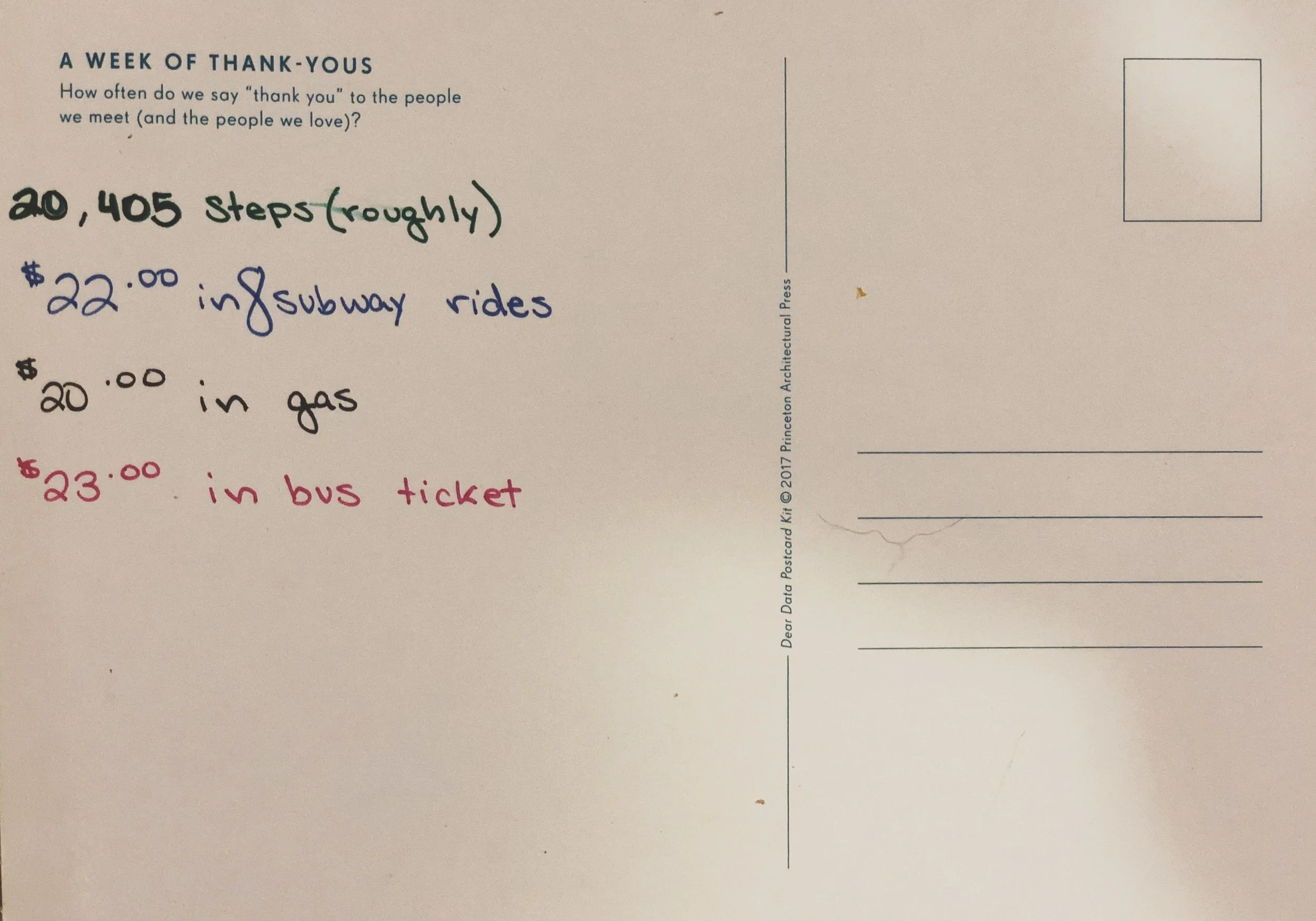
I then took all this and tried (+ failed) to visualize it. Not my best work, but here is my Dear Data postcard:

and on the back, I wrote out my estimated costs:
Assignment #1 - Interactive Viz Critique -
So, I’ve been looking at a lot of visualizations, and a lot of them are just so HEAVY. So I wanted to focus on this one: Queen Four Visions. I found it exploring Behance.
https://www.behance.net/gallery/6172023/Queen-Four-Visions
Here’s a better PDF version of the visualization, one you can zoom in and out of.
http://www.digitalcreative.it/wp-content/uploads/2015/12/Queen-four-visions.pdf

So essentially, this visualization took the five most used words in Queen songs and analyzed the frequency of each word. This way they were able to trace back to who was the author of each song, as each band member would use each word at a different frequency.
I really enjoyed looking at this visualization. It makes it pretty clear who wrote what but also, what themes each band member focused on.
Clear, bright colors are what I feel like make this visual stand out. Also, I just really love Queen and rock music in general.
I think that if you follow each artists’ color, it kind of tells a story. For example, Brian May, throughout his career wrote a lot about love, but had a period of time in the middle of his career with queen where he had a lot of focus on time, which then led him to later on in his career think and write more on themes relating to life. Although this could lead to assumptions, I feel like it tells a story of a man who overtime shifted his focus from love to time to life.
Song lyrics and music in general is one of those things that connects humans on a completely different level. Music can connect strangers in a way almost nothing else can.
I feel like this visual is easy to trust and doesn’t cause me any uncertainty, simply because there isn’t much to gain in misleading anyone viewing it. Also because it details just how the creators used resources from the web as well as word counters to count exactly how many times a word was used. Also, this visualization only serves the purpose of informing anyone who cares about Queen lyrics and themes throughout them.
I think the only thing I would improve on this is that it initially is a lot to look at and it took me quite some time to be able to get through a lot of it. I know this is something that can happen with visualizations that have a lot to say, so it’s not an easy problem to fix.
That’s all for now! See ya later Joey, and anyone else actually reading these… cause I guess this is the internet, which is a big and scary place that almost anyone can get to…
Quite the Year
It has really been one of the hardest years of my life, and we only just hit June. Halfway through what feels like the absolute worst rollercoaster I have ever been on. But this time, I did not elect to even get on this.
Oftentimes we are thrust into these experiences, these awful roles that no one would have signed themselves up for, given the chance. I was not given the opportunity to say "no, I don't want to do this." Because when loved ones call, you answer - literally and metaphorically.
I know it's been a few months since my last post, but the truth is, I found it hard to care about anything at all - my classes, my grades (how did I still end up with a near perfect semester, grade-wise?), my peers, my friends, all that mattered was my father. My father, my best friend, my partner in crime, my hero. My dad passed away on April, 20th 2018. Whenever I tell someone the question is "oh my goodness, are you okay??" and I always say I'm fine, but that will probably never be 100% true. It's a process, they say. It has its ups and it has its downs. But honestly, if I could have it my way, I would trade it all in just to get 5 minutes with my dad again.
This experience, unfortunately, has taught me so much. My role of helping my mother and sister be caregivers, is over. I now do feel like I can move forward, at least with my thesis, and look at things with fresh eyes. I've started to slowly get back to work to try to wrap up some of my projects for the beginning stages of my thesis, and I do feel like moving in the direction of approaching a healthcare related topic from the role of young caregivers is where I want to take this.
Young caregivers face unique challenges in being put in a position of caring for a loved one. I want to, ideally, approach this topic with the following in mind:
- I want the young caregivers I work with to have been put in this position unexpectedly.
- I want to work with individuals between the ages of 18 and 25. I'm open to a few years older, but in research, "young caregiver" is classified between anyone between 18 and 25.
- Ideally, it would be great to work with individuals who are in the NYC area, but I'm open to travel a bit, if possible, to work with those in other areas.
- I don't want to create just another support group. Despite not being many, these already exist and face their own challenges in being effective to ease the burden of caregiving. (plus, many active caregivers don't feel as if they even have time to devote to a support group)
I want to understand the challenges that these caregivers are faced, I then want to ideally create something -- some experience, some product, some resource -- that helps ease the burdens and challenges these young caregivers face.
The Caregiver Experience - A lost approach to finding a thesis topic
There was a moment of pause, more like a few weeks of inaction, where I really thought "I have absolutely no idea, no clue, what my thesis will be about. I don't even know what it will relate to specifically." There were though, a few knowns that I knew I had to dive headfirst into if I wanted to get anywhere at all.
There was a moment of pause, more like a few weeks of inaction, where I really thought "I have absolutely no idea, no clue, what my thesis will be about. I don't even know what it will relate to specifically." There were though, a few knowns that I knew I had to dive headfirst into if I wanted to get anywhere at all.
The knowns:
1. It will be related to healthcare. I want to go into healthcare, an industry I honestly think is dirty, grimy, full of money-hungry assholes. Wait - why do I want to work in this again?
2. It will be beautiful. I know the end product will involve my photography skills. I know the end result will be something impressive, but that doesn't help me at all. Oftentimes having something to work towards is helpful. In this case, it is not.
So I did something I don't do enough. I listened. I began to listen to the conversations around me. I began to listen to the pains and complaints of some of those close to me. I listened to my professor, Allison, who told me to take a curious approach to the things I often thought I knew all about. This is what happened, this is what I heard:
When somebody falls ill in a family, they often rely on those around them to hold them up - metaphorically. I have seen countless instances of friends taking care of their parents, grandparents, siblings, etc. when they get sick. Sometimes it's a quick, flu, type of illness. Other times, unfortunately so, it is not so much something quick. Oftentimes, it's something that lingers on the spirit and weighs it down. Oftentimes, it is something that no one would wish on anyone else, not even their worst enemy, to be cliche.
First hand, I have seen this. And I have seen the strength, a strength that comes at a cost and honestly a strength that many would rather never have to gain because that means they had to go through something horrible, such as watching a loved one go through a severe illness.
I often speak on improving the patient experience, but also, the primary caregiver has an experience that, along with many others, could be improved.
Next Steps:
Speak to primary caregivers. I put the call out on my personal social media channels, Twitter, Facebook, and Instagram. I don't want to make anyone relive an experience they don't want to, which is why I haven't directly reached out to anyone yet. I am waiting to see who is open to speaking on their experience, from there I will see what themes emerge and what seems like an interesting direction to take this in. Stay tuned. I have three conversations scheduled for later today.
A Final Presentation
What it all comes down to. A class presentation:
What it all comes down to. A class presentation:
Concept Prototyping: "Bernice's Kitchen"
A few ideas and concepts emerged last week when trying to nail down a concept to protoype. I knew some concepts were a bit easier to prototype than others, but I wanted to make use of 1. my weekend at home and 2. the prototype that, although a bit more difficult, also would have a greater effect.
A few ideas and concepts emerged last week when trying to nail down a concept to protoype. I knew some concepts were a bit easier to prototype than others, but I wanted to make use of 1. my weekend at home and 2. the prototype that, although a bit more difficult, also would have a greater effect. I really wanted to get my sister into the kitchen and thought "hmm the meal service concept, with a few tweaks, might actually work."
I knew that I wouldn't have time to find a meal service and order one that my sister may actually enjoy, so I modified the concept a bit and created my own meal service. I present to you: Bernice's Kitchen!


I wanted to create something fun and familiar for my sister. Who is Bernice, you may ask? Well she's my sister's horrible, mean cat. She hates me, or the sound of my voice I suppose. For no reason, because if anyone knows me, I'm such an animal person. I don't know what her problem is, but she's a cat so I suppose I never will. There she is on the right, exhibit A, her hissing at me. Which led to this amazing picture. But not the point.
So, I decided to go with Bernice's Kitchen because well, I knew my sister would enjoy it, it would add an element of sillness and fun to this whole process and we both needed a dose of fun and silly at this point. Especially as I geared her up to get her into the kitchen.
Inside of the "Bernice's Kitchen - Meal Delivery Service" bag, there were detailed instructions on what steps to take next, what was included in the bag, and the recipe.
What were we making? Buffalo Cauliflower. I chose this recipe because I knew my sister was curious to try these, it was more of a snack and less of a commitment, and it was super easy to make, with very little prep needed and not too many ingredients involved.
So we were off. And in about 40 minutes, they were done and ready to be enjoyed (or not so much enjoyed).


So, she didn't love it. Actually, I don't think she liked how they tasted at all. I think she was hoping the buffalo sauce would cover up the taste of cauliflower. It's a little frustrating when working with taste, because that's not something that you can just shift overnight or with a prototype such as this.
What was interesting was that she seemed to somewhat really enjoy the process, everything was basically cut, measured, and separated out for her. It was a super easy, simple process of emptying out pre-measured cups of different ingredients into a bowl, mixing, and putting in the oven (a few more steps than this, but you get the idea, it was EASY). And that's what was the most successful part of this.
Moving forward I recognize the need to ease for my sister. If it's easier for her to do she may be more inclined to do it and who knows, maybe it'll lead to more diverse eating options.
Another step moving forward is that I want to create a comparison chart of the various meal delivery service options that exist for my sister - complete with some sample meals they may send her. Her biggest hesitation was essentially "yeah it's great it's easy, but what if they just end up sending me a bunch of meals I end up hating." Which I get, with a limited taste pallet, I wouldn't want to spend time and money on a service that just sends me things I don't enjoy eating. We'll see how this goes, but it may be out of the scope of this project as technically, it's ending and over today.
Moral of the story: Eat your veggies kids. Try new things. Don't judge a book (or vegetable) by its cover.
The HMW Process
"How might we better create a way for my sister to live out a healthier lifestyle?"
This has been the overarching idea since getting to the root cause of why my sister wants to live out a healthier lifestyle. Had she said "I want to be healthier because I want to lose 5 pounds" I feel like my work may take a whole different direction and potentially be much easier. But, alas, it is never that easy.
"How might we better create a way for my sister to live out a healthier lifestyle?"
This has been the overarching idea since getting to the root cause of why my sister wants to live out a healthier lifestyle. Had she said "I want to be healthier because I want to lose 5 pounds" I feel like my work may take a whole different direction and potentially be much easier. But, alas, it is never that easy.
The process of getting to some more tangible, concept ideas really heavily relied on the HMW process. The "How Might We" process is not necessarily a silver silver bullet solution, it often does not even take the shape of a solution or concept at all, but it nails down the needs we are trying to address in more of a concrete way.
So instead of saying "sow might we better create a way for my sister to live out a healthier lifestyle?" we could shift that to:
"How might we have less leftover ingredients Carolina might not have any use of, while still getting her to try new things recipes?
The concept that comes along with this is that of getting her to try a meal delivery service. This will be the first concept prototype, but instead of actually getting her to order a meal, I will sort of recreate the experience in a low fidelity way so as to test with low risk.
Another, more concrete, yet still a bit abstract HMW statement could be:
"How do we get Carolina more excited when it comes to trying new recipes"
My sister has two main hesitations: one is getting her hands dirty in the kitchen, and the other is trying foods outside her regular scope. To address the former, I feel that the meal delivery service might be a good place to begin. Pre-cut, pre-measured, and for the most part, pre-mixed ingredients could make for an easier and less traumatizing experience in the kitchen.
The former, getting her to venture outside of her regular scope of foods and try some new options, that one will take a bit more creativity, research, and thought.

One last thing: I got a pretty interesting insight from her the other day. She said that if there's a lot of evidence, some sort of article or documentary of some sort that explains the downsides to eating some sort of food, she feels heavily influenced by that. Unlike me, after watching Super Size me and learning about "pink slime" I'm pretty sure I just wanted some chicken nuggets from McDonald's... but alas, I am the furthest thing from a picky eater... sometimes to a fault.
What does "healthy" mean to you? 5 Why's
When talking to a 2nd year grad student in my program, he brought up a good point. I told him my project was focused on helping my sister be more "healthy." He asked "well, what does healthy even mean to her?" and I couldn't really answer that. It could be a final goal of losing 10lbs or it could be a whole lifestyle thing, I wasn't sure. So I set out to better define what healthy even means to her, and to understand why she wanted to be whatever definition of healthy she had for herself.
When talking to a 2nd year grad student in my program, he brought up a good point. I told him my project was focused on helping my sister be more "healthy." He asked "well, what does healthy even mean to her?" and I couldn't really answer that. It could be a final goal of losing 10lbs or it could be a whole lifestyle thing, I wasn't sure. So I set out to better define what healthy even means to her, and to understand why she wanted to be whatever definition of healthy she had for herself.
The "5 Why's" activity is one of my favorites because, although potentially very annoying, it gets you to a deeper insight that may not be considered when answering a question initially. If you keep exploring with someone why they believe a certain something or feel a certain way about something, and you keep asking them "why" you often get an answer, after a few "why's," that provides you with a deeper understanding of a person's priorities. Below is the 5 Why's conversation I had with my sister (via text messages):
So, tell me, what does being healthy mean to you?
"Fruits, vegetables, low calories, low fat intake. It's a daily thing, like just because I lose 5lbs doesn't mean I'm healthy. Maintaining a balanced diet that's more vegan / vegetarian. Drinking water and working out regularly."
why more vegan / vegetarian?
"It’s the healthiest option and still gives me all the nutrients I need."
why?
"Because it’s not processed so it has organic nutrients."
why?
"Because that would be bad for my body."
why?
"well, eventually your body will break down from all the crap"
why?
"you're driving me insane with these questions. because I don't want to have cancer or heart disease or be overweight / obese. I don't want to have to take 298 different medications, I don't want to be in the hospital. Like, I do not want to be a happy 60 year old then BOOM. I have cancer or diabetes, etc."
So the insight began with "I want a healthier lifestyle because it's good for the body" and soon, with enough questioning and prodding, we got to the source of why she feels it's important to keep a healthy lifestyle: because she does not want to pay for it later in having cancer or diabetes or some other disease that could have been avoided by healthier eating now.
Getting to some key questions...
The follow chart I created in an attempt to better lay out and understand (perhaps) what direction this research is taking me. I chose to focus on three objectives and build from there:
The follow chart I created in an attempt to better lay out and understand (perhaps) what direction this research is taking me. I chose to focus on three objectives and build from there:

What A Wonderful World
How did we get here? In the matter of a year I have had more conversations, bordering on arguments, about things that I never thought in 2018 I would have to be defending. Gay / Trans rights, equal pay and treatment for women, CONSENT, Immigrant and Refugee rights, and the list goes on and on and on. Last weekend was the one year anniversary of the Women's March as well as one year since hate, racism, intolerance, xenophobia, and ignorance has taken office and a hold on this country. Some days it feels exhausting to fight, but fight we must.
How did we get here? In the matter of a year I have had more conversations, bordering on arguments, about things that I never thought in 2018 I would have to be defending. Gay / Trans rights, equal pay and treatment for women, CONSENT, Immigrant and Refugee rights, and the list goes on and on and on. Last weekend was the one year anniversary of the Women's March as well as one year since hate, racism, intolerance, xenophobia, and ignorance has taken office and a hold on this country. Some days it feels exhausting to fight, but fight we must.
In other news, I've been continuing on my journey to help my sister address her difficulties with eating healthy -- a project focused on helping me prepare for the process of writing a final graduate thesis.
Essentially my sister is not a fan of vegetables, feels hope that there is a vegetable out there she would enjoy, is wary about trying new things. The themes of unfamiliarity, reducing waste, and accessibility came up when discussing her difficulties with keeping a healthy diet.
I think at this point it is important to discuss and further define what healthy means for her. I think healthy can be such a relative term, different to all. If her goal if to be "healthy" isn't it important to first have her define for herself what that means?
A Graduate Thesis
In my intro to thesis class my professor asked us to keep up with a blog in order to demonstrate our growth as we go through developing a thesis as well as a way to document improvement as we work through the DSI program.
In my intro to thesis class my professor asked us to keep up with a blog in order to demonstrate our growth as we go through developing a thesis as well as a way to document improvement as we work through the DSI program.
If you're reading this and you're thinking "I'm a little lost, what is DSI? What is this girl talking about?" That's okay. Here you can read a little bit more on what I'm going to school for, what I hope to do with my life, and who I am.
Okay -- let's get started. As a part of our thesis course we spend the first seven weeks working on a "mini-thesis." What makes this easy, for me at least, is that our prof already gave us a topic of sorts -- we have to work with one person to understand some sort of food related issue they may have and figure out a way to address that. Immediately what came to mind was my sister, because we had just talked about how much she wants to change her eating habits to be a bit more healthy, but she does not find many vegetables and commonly known "healthy" foods very enjoyable, nor does she have a lot of extra free time to figure out what she does like, how to cook it, actually preparing it, etc.
Thought this would be a fun project not only because it pertains to food but also it'll be an opportunity to work with my sister and maybe it will help her gain some more clarity on what the heck my MFA degree is in.